
From Empty Shelves to a Digital Nation: How Estonia Rethought Government

“It was cold in Estonia in January 1992,” recalled Mart Laar, Estonia’s first post-Soviet prime minister. “The collapse of the Soviet system left the country in chaos. Shops were empty. The Russian ruble was worthless. Prices were soaring. Inflation topped 1,000 percent.”
Today, Estonia is one of the most digitally advanced societies in the world. Citizens can file taxes, sign contracts, and even vote online. But none of this was even imaginable in the 1990s. Western media often dismissed Estonia as “just another former Soviet republic”, as Laar later recalled.
Born from scarcity and a handful of bold early decisions, Estonia’s digital journey poses a striking question: how could a nation that once struggled with empty shelves in 1992 build a digital state the world’s wealthiest countries cannot replicate in 2026?
Act 1: Building the State - From Soviet Collapse to Administrative Foundations
On 20 August 1991, Estonia declared its independence from the Soviet Union. The celebrations quickly collided with the reality of institutional collapse.
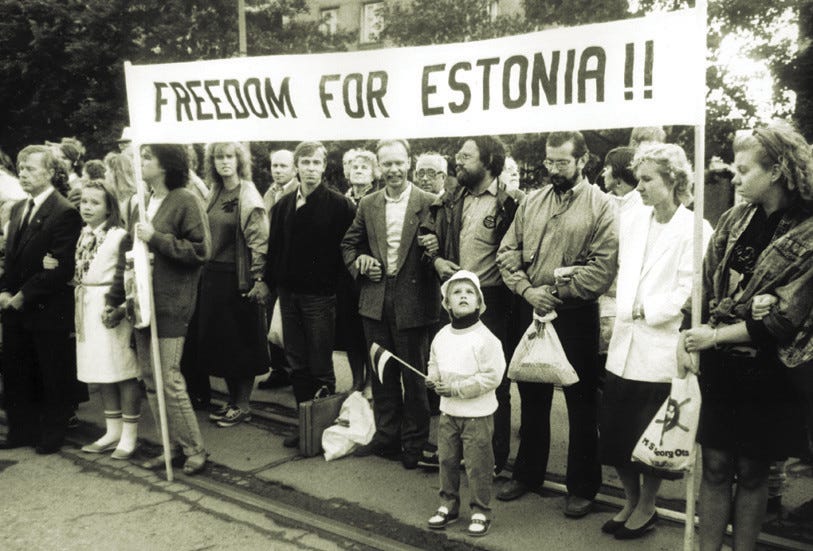
Uncertainty and fear marked the early years. “I don’t think we fully realized how difficult it was going to be. Everything is going downhill very fast,” Kristel Murel, a 35-year-old mother of a four-year-old, told The Washington Post in 1992.
While chaos was visible, preparation was already underway. In the 1980s, Soviet reforms such as perestroika (restructure) and glasnost (openness) weakened central control and allowed limited public debate. Reform-minded Estonians used this opening to organise, test ideas, and quietly prepare for independence.
One question dominated these discussions: who belonged to the country, and on what legal basis? This was not an abstract concern. It shaped decisions about elections, property rights, welfare systems, and the structure of the state itself.
Estonia’s answer was both symbolic and strategic. Rather than declaring itself a new state, it claimed legal continuity with the republic founded in 1918, treating the Soviet occupation as illegal. Citizenship was restored to descendants of pre-1940 citizens. This clean break from Soviet authority came with an immediate complication. At independence, nearly 40% of the population consisted of Soviet-era migrants and their descendants, many of whom now faced questions about status and naturalisation.
Legal continuity created administrative clarity, but the newly defined population still needed to be made legible to the state. Even before independence, Estonia began assigning Personal Identification Codes (PIC) in 1989. The goal was governability. Without a reliable way to identify people, the state could not run elections, distribute benefits, or settle property claims in a system already fragile from occupation.
PICs were not a digital initiative. They were a response to political problems of legitimacy and coordination. Only later would they become the foundation for a universal, state-backed identity and the backbone of Estonia’s digital state.
With legal and administrative foundations in place, Estonia moved quickly when the Soviet Union finally collapsed in late 1991. A new constitution was adopted by referendum in June 1992. In October, the first Riigikogu (parliament) was sworn in under that constitution, and Mart Laar, just 32 years old, became the first democratically elected prime minister of the restored republic.
Laar later summarised the logic of those early decisions: “One is to take care of politics first and then to proceed with economic reform. Don’t underestimate the importance of a new modern constitution and democratic legislation on elections.”
Act 2: Governing with Scarcity - Innovation Born of Necessity
With legal sovereignty regained but little administrative capacity, Estonia needed to rebuild quickly. “The old system has broken down, but the new system doesn’t function yet,” Ants Promann, a manager at Tallinn’s Leibur bread factory, told The Washington Post in 1992.
Ideas and political will existed, but the civil service was small, funding limited, and the population still recovering from economic shock. A paper-based bureaucracy of forms, queues, and offices was too expensive. If the state was going to function at all, it would have to function differently.
A small network of highly educated elites formed the core of early institutional rebuilding and would later prove crucial to Estonia’s digital transformation. Their influence rested on a deep base of technical expertise, shaped by institutions like the Institute of Cybernetics, which conducted computing research and helped develop the first home-grown personal computer, ‘Juku,’ in the 1980s. This combination of talent and experience made experimentation in state design possible.
Scarce resources made experimentation a necessity. Long procurement cycles, large bureaucracies, or imported systems designed for wealthier states could all become permanent burdens. Estonia adopted a principle of avoiding the ‘legacy trap’, articulated in a 1993 memo by Raimund Ubar, a professor of computer engineering at Tallinn University: “It is not sensible to overreact and start immediately buying things. Don’t buy anything old.” Agencies were encouraged to develop local, specialised solutions rather than overpay for legacy systems.
Similar insights emerged in foreign policy circles. In 1993, Toomas Ilves, Estonia’s ambassador to the United States, encountered Mosaic, one of the first commercial web browsers. He realised that the internet offered a rare level playing field: all countries, rich or poor, newly independent or long established, were starting from the same point. Estonia’s past would not hold it back.
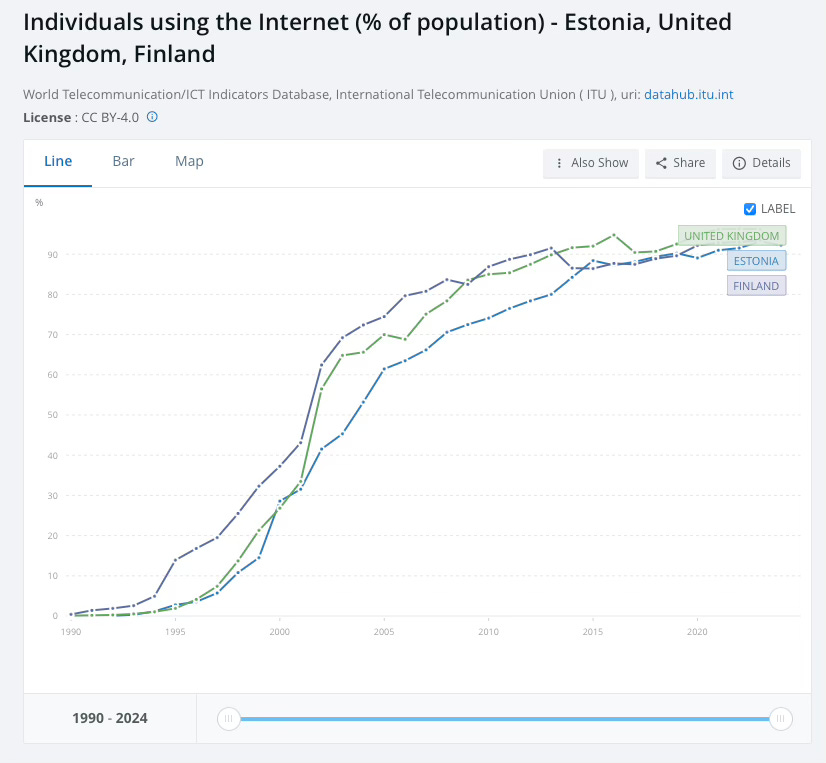
If the country were to leapfrog into the future, the state needed to invest deliberately in digital infrastructure. This perspective informed the 1994 draft of the “Principles of Estonian Information Policy”, which earmarked 1% of GDP as stable IT funding. To prepare citizens for this future, Estonia prioritised digital literacy, most notably through the Tiger Leap programme launched in 1996, which brought computers and internet access to all schools. At the same time, banks rolled out e-services, a necessity in a country with low population density and high costs for physical branches. Early e-banking exposed the population to everyday digital interactions, laying the groundwork for later innovations like the e-ID.
Act 3: Architecting a Digital Nation - Turning Ambition in Architecture
By 1998, the Tiger Leap programme had connected every school to the internet; by 2000, Estonia became the first country to declare internet access a basic need. The challenge was no longer whether to go digital, but how to turn ambition into state infrastructure.
In hindsight, Estonia’s digital foundations can seem like a tidy sequence of reforms. The reality was messier. Policymakers, lawyers, and engineers faced a tangle of interdependent problems: How could citizens authenticate themselves online? How could digital actions carry legal weight? And how could fragmented agencies share data securely? Each technical puzzle mattered because it directly shaped citizens’ everyday experiences.
These challenges were addressed almost in parallel.
To move services online, the state needed digital signatures to carry legal weight. This led to the Digital Signature Act of 2000, which declared digital signatures legally equivalent to handwritten ones. But a signature is meaningless without reliable identity, and identity alone could not solve the problem of fragmented data spread across institutional silos.
In 2001, Estonia launched X-Road, letting agencies share data securely without centralising it. Trust was built into the architecture. The system logged every query and agencies could access only the information they were legally allowed. X-Road also implemented the once-only principle, so citizens never had to give the same information twice to multiple agencies. Government interactions became seamless and far less burdensome.
Estonia rolled out a mandatory national identity card (eID) in 2002, a physical card that enabled secure authentication and legally binding digital signatures. Unlike many countries that treated digital identity as optional or experimental, every resident aged 15 and over was required to have one. This was a political choice to ensure digital services would reach everyone.
Adoption, however, was slow. Many citizens did not yet understand why they needed a digital identity or what it could do, and using it required a card reader, which not everyone had. Raul Kaidro, CEO of RaulWalter, a company involved in early eID adoption, later recalled: “In the early 2000s, we ran initiatives to train people on using electronic services such as the eID and digital signature. This kind of education or skill set is crucial when you think about digitalisation.”
The turning point came with usefulness.
Launched as early as 2000, the e-Tax Board was designed to support online tax declaration. Uptake was modest at first, but the real benefits appeared after the rollout of X-Road and the eID. The process became seamless: citizens logged in with eID, reviewed pre-filled forms populated from multiple registers, and signed digitally. No paperwork. No offices to visit. No signatures to chase. Adoption climbed steadily, reaching 59% by 2004 and 98% by 2019, establishing e-Tax as one of Estonia’s most visible digital successes.
As digital infrastructure demonstrated tangible benefits, use of digital ID grew. What had once been dismissed as “a piece of plastic only good for scraping ice off a windshield” became a practical tool of everyday life.
Increasing adoption highlighted the need for a more convenient system. The card-reader–dependent eID was replaced in 2007 by a SIM-based Mobile-ID (mID), and as mobile carriers transitioned to eSIMs, Estonia introduced Smart-ID, a mobile authentication app. These improvements enhanced customer experience and reinforced trust in the digital state.

Lessons for the AI Era
Estonia’s story is often told as a tale of technology. In reality, it is about a state under pressure, forced to innovate, rethink authority, and design systems that work for everyone. By 2024, Estonia became the only country delivering all government services digitally, including marriages and divorces.
The key lessons from Estonia that are particularly relevant for governments and organisations grappling with AI adoption:
Act decisively, experiment boldly - Estonia’s leaders showed a bias toward action, a “just do it” mentality. Early setbacks, citizen skepticism, and cyberattacks strengthened the system. AI adoption benefits from the same iterative, hands-on approach, learning from early failures rather than waiting for perfect solutions.
Rethink from first principles - Estonia did not just digitise forms; it reimagined how services could function in a digital era. Workflows were redesigned from the ground up rather than layering technology on old systems. AI adoption requires questioning assumptions, rethinking processes, and avoiding retrofitting intelligence onto systems that were never designed for it.
Build trust through usefulness and infrastructure - Estonia earned citizen trust by making services genuinely helpful, interoperable, and inclusive. AI tools must deliver clear benefits, maintain transparency, and respect privacy. Users trust systems that are reliable, practical, and fair.
Estonia is extending its digital foundations into AI with initiatives like Burokratt, a distributed AI system that can, for example, alert a citizen if a tax refund is due or automatically schedule a needed permit, and the AI Leap programme, which will train the workforce for an AI-powered future. By building on proven citizen-centric principles, Estonia ensures AI serves the people.
Estonia shows that digital transformation is about more than technology. Bold action, redesigning systems from first principles, and trust-driven design turn ambition into lasting impact. As AI reshapes governments and organisations, Estonia offers a blueprint: experiment, iterate, and build infrastructure that scales while serving people effectively. The country’s journey reminds us that the future favours those willing to rethink how services are delivered from the ground up.
Further reading
For readers who want to go deeper, the following sources shaped the research and perspective behind this piece.
The story of e-Estonia: A visual, timeline-based overview of Estonia’s digital journey, useful for orienting the broader sequence of reforms.
Estonia - The Small Country that Could, by Mart Laar: A first-hand, vivid account of the years leading up to independence, capturing how reform-minded Estonians prepared politically and institutionally before sovereignty was restored.
The Estonian Economic Miracle, by Mart Laar: A retrospective narrative of the early independence period, detailing the economic reforms implemented during Laar’s tenure (the PDF version is more readable).
The History of Digital Identity in Estonia, by Cybernetica: An accessible account of the technical and architectural evolution of digital ID and X-Road by an organisation directly involved in their development.
Estonia - A Successfully Integrated Population-Registration and Identity Management System Delivery Public Services Effectively, by The World Bank: A detailed case study of Estonia’s personal identification system and its role in state capacity, service delivery, and governance.
Estonia’s digital transformation: Mission mystique and the hiding hand, by Rainer Kattel and Ines Mergel: A rigorous, systems-level analysis of how institutional design, elite networks, and policy sequencing shaped Estonia’s digital state.
Dear Ma'am.
May I be the first one to congratulate you on a wll-research article on Estonia and the progress made by the erstwhile member the then Soviet Union?
I would like to focus proudly on the progress my country ,India ,of over 1.4 Billion has made on a much larger scale ,since circa 2014.
We have the Aadhar, which is on a much larger scale than the SSNof the US. Every individual citizen is identified through facial and iris scan,over and above finger prints. Our Unified Payment Interface has billions of transactions every month ,for as small a payment,as you can imagine,where no cash changes hands .And above all ,this process has been achieved as a thriving democracy ,unlike China.To top it all we are now the fourth largest economy in the world!
I am eagerly looking forward to your next article and to read your views on various topics. May God grant more power to your pen! Amen!!
Vijay Ambre